
Italy Championing recycling of packaging waste
Italy Championing in recycling of packaging waste and organic waste treatment, BIOPAP® forerunner in compostable, high-performance food packaging solutions.
The recycling of packaging waste in Italy continues reaching levels of European excellence: in 2023 it reached 75.3%, up from 70.7% in 2022, exceeding not only the European 65% target by 2025, but also that of 70% by 2030.
The results have been published on Friday 13 December 2024 at the National Conference of the Recycling Industry, promoted by the Foundation for Sustainable Development in collaboration with Conai and Pianeta 2030, the monthly magazine of Corriere della Sera, under the patronage of the Ministry of the Environment and Energy Security, Ispra and the National System for Environmental Protection.
Almost all supply chains exceed the European targets: paper and cardboard 92.3%, steel 87.8%, glass 77.4% (even if it is down by 3.4% if compared to the previous year), aluminum 70.3%, wood 64.9% and bioplastics 56.9%.
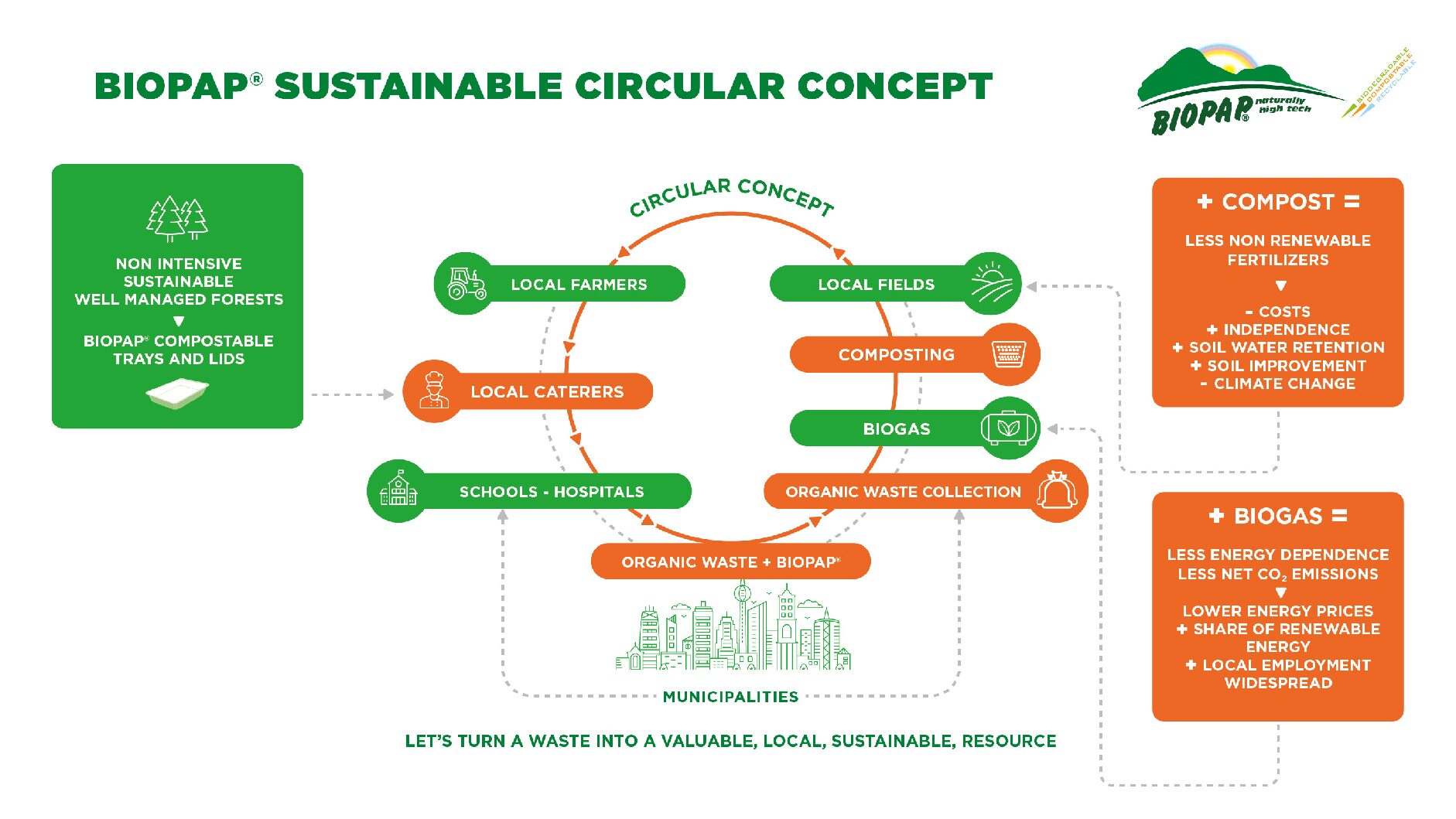
In Italy certified compostable packaging are processed together with urban organic waste in organic recycling plants. Typically, BIOPAP® certified compostable trays and meal trays used by professional caterers for school, corporate, hospital catering are collected with food residues in biowaste and turned to quality compost.


Italy is a forerunner in biowaste collection and treatment. Today it has a capacity for treating organic waste (green and organic municipal waste) that guarantees the self-sufficiency of the national System with a network of 357 plants distributed throughout the territory treating approximately 5 Mt of municipal waste, including compostable food packaging and compostable bioplastic products.
About 52 million inhabitants are involved in intensive collection schemes for biowaste (foodwaste + greenwaste) diverting about 7,4 Mtons of biowaste from disposal to recycling, converted into compost and turned back to agriculture, landscaping and orchards. Moreover the integration of composting with the anaerobic digestion process also made it possible to obtain approximately 409 Mm³ of biogas, part of which used for the production of electricity (approximately 411 GWh) and thermal energy (approximately 169 GWh).
A success for the circular bioeconomy, using local resources, creating local jobs and helping in significantly reducing CO2 and Methane emission from organic waste landfilling or incineration.
At BIOPAP we have been believing in circular Bio-economy for over 22 years now. All our food packaging solutions have been eco-designed with renewable and non-agricultural raw materials and certified compostable to allow an even larger share of food waste collection to the composting stream.
CIC estimates about 2.000 workers directly employed in biowaste sector and 10.000 employees in the other activities related to the biowaste recycling (i.e. collection, technical support for planning and building plants, activities to promote the use of compost), with steady growth prospects in the future.