



Position Paper BIOPAP® for professional catering
BIOPAP® POSITION PAPER ON PPWR (EU REGULATION 2025/40)
- Executive Summary
BIOPAP® Società Benefit proposes an industrial model aligned with the PPWR (EU Regulation 2025/40) that maximizes the valorisation of biowaste through compostable packaging designed for collective catering.
In this context, compostable is not a generic alternative but a high-efficiency systemic solution where recycling and reuse are suboptimal.
Key element: European biowaste represents a largely untapped resource with strategic potential for renewable energy (biomethane) and soil fertility.
- Strategic positioning within PPWR
The PPWR prioritizes:
- Reduction
- Reuse
- Recycling
- Compostability (in specific applications)
BIOPAP® is strategically positioned where:
- reuse is inefficient (hygiene constraints, logistics, costs)
- recycling is compromised by food contamination
- an efficient organic waste infrastructure exists
- Biowaste: a strategic European asset
Europe generates significant volumes of organic waste that are not fully valorised.
Full activation of the biowaste value chain would enable:
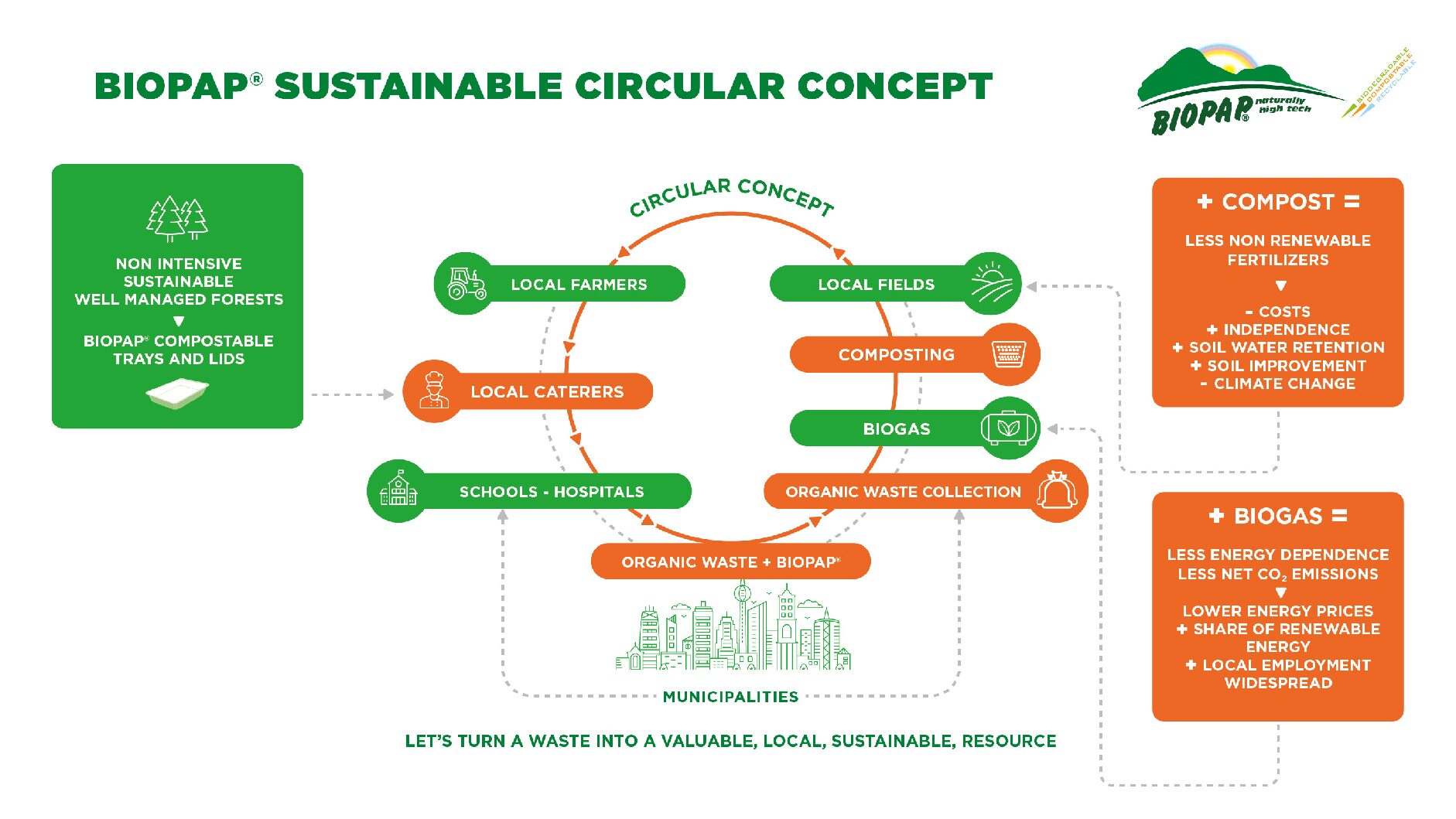
- Biomethane production → reduced energy dependency
- Compost production → reduced use of chemical (especially nitrogen-based) fertilizers
- Improved soil quality
- Increased soil organic carbon (biogenic carbon sink)
BIOPAP® enables this system by improving collection efficiency and organic waste quality.
- Italian model: European benchmark
Italy represents an advanced system:
- high separate collection of organic waste (together with certified compostable packaging)
- integration of composting and anaerobic digestion
- agricultural use of compost
BIOPAP® is designed to maximize performance within this ecosystem.
- BIOPAP® competitive advantage
5.1 Advanced certifications
- EN 13432
- CIC certification
- OK compost HOME
- BPI (USA)
- Suitability for biomethanisation
5.2 Real differentiation
The CIC certification is a unique differentiator:
- validation by real plant operators
- disintegration testing in real scale conditions
- Optimal application: collective catering
Ideal contexts:
- corporate canteens
- schools
- hospitals
- organized catering
Benefits:
- combined collection of food waste and packaging
- reduced sorting errors
- improved input quality for treatment plants
- higher capture of biowaste (food leftovers)
Why collective catering is the leverage point:
- concentrated waste streams
- high food contamination
- controllable systems (closed loop)
- Competitive positioning
BIOPAP® is:
- an optimal solution in integrated organic waste systems
- an enabler of real circular economy
- Conclusion
BIOPAP® represents an advanced and strategic solution within the PPWR framework, delivering significant impacts in energy, agriculture, and circularity when applied in the right contexts.

