Certificazioni

    News

    News

    BIOPAP® meets students

    Thanks to the Professors of ITET Aulo Ceccato school in Thiene (VI) who organized the meeting and thanks to the students who participated with so many questions.

    On April 26th, we completed the second day dedicated to students; the first one was held on April 13th, and we are happy with the enthusiasm we generated.


    Doing business also means interaction with communities and in particular with young people who will be its interlocutors and players in the future. That is why in BIOPAP we annually organize a series of meetings-visits with high school or professional school classes in order to describe to the students the various aspects of life in the company.


    In particular, we explain the specifities of BIOPAP, the way our sustainability path was born and developed, the role and social commitment of the company and the people behind it, as well as the values that should bind company-environment-community. Our idea of food containers suitable for containing, transporting, preserving, cooking or heating food has as its ultimate goal to minimize resource use, make processes more efficient and integrate end-of-life into a circular system. We bring to the young students the example that you can be visionary and be successful, that every decision must take into account the impact it will have in the future, that commitment must always be long-term, and that results always come from teamwork. People from the different business functions explain their tasks, the activities they perform, and their interactions with the rest of the company and its ecosystem.  We want to convey everyday life in the company: future-making every day.

    Notizie

    BIOPAP® MAP nominated for the CFIA 2023 Innovation Award

    The nomination of BIOPAP® MAP patented trays for modified atmosphere packaging to the CFIA 2023 innovation trophy is a further confirmation of BIOPAP®’s capacity for innovation and of our structured presence in France.

    We are proud and happy about this result among more than 100 innovations with a resounding echo in all specialized media.

    As part of our ongoing R&D, we have developed a new material and manufacturing technology to achieve large-scale production of the first recyclable and EN 13432 compostable paper-based food tray suitable for sealing and preservation of food in  modified atmosphere.

    BIOPAP® MAP was chosen as a finalist by the prestigious CFIA Jury in the « Packaging Section », for the innovation that it brings to the food industry in terms of technical, environmental and sanitary performance.

    With BIOPAP® MAP trays we offer to the ready meals sector many advantages such as ease of use for consumers who can use them from the refrigerator to the microwave and traditional oven up to 145°C. An ideal container to heat the food and consume it in the tray without using a plate and then having to wash it, thus wasting water and time. Moreover, the very high oxygen barrier guarantees long shelf life and reduces food waste, one of the main ways to fight against climate change. BIOPAP® MAP, a powerful impact in terms of touch and visual naturalness, thanks to the possibility of external printing that brings the quality and brand of fresh food preparations to the consumers’ table, avoiding over-packaging.

    With BIOPAP® MAP, the leading players in the food industry now have the possibility of having in their hands a decisive and essential element to enhance the value of their products and to participate with commitment in the transition towards more natural, healthy and truly eco-responsible renewable packaging.

    Michelangelo Anderlini – Biopap® President and Co-founder
    News, Notizie

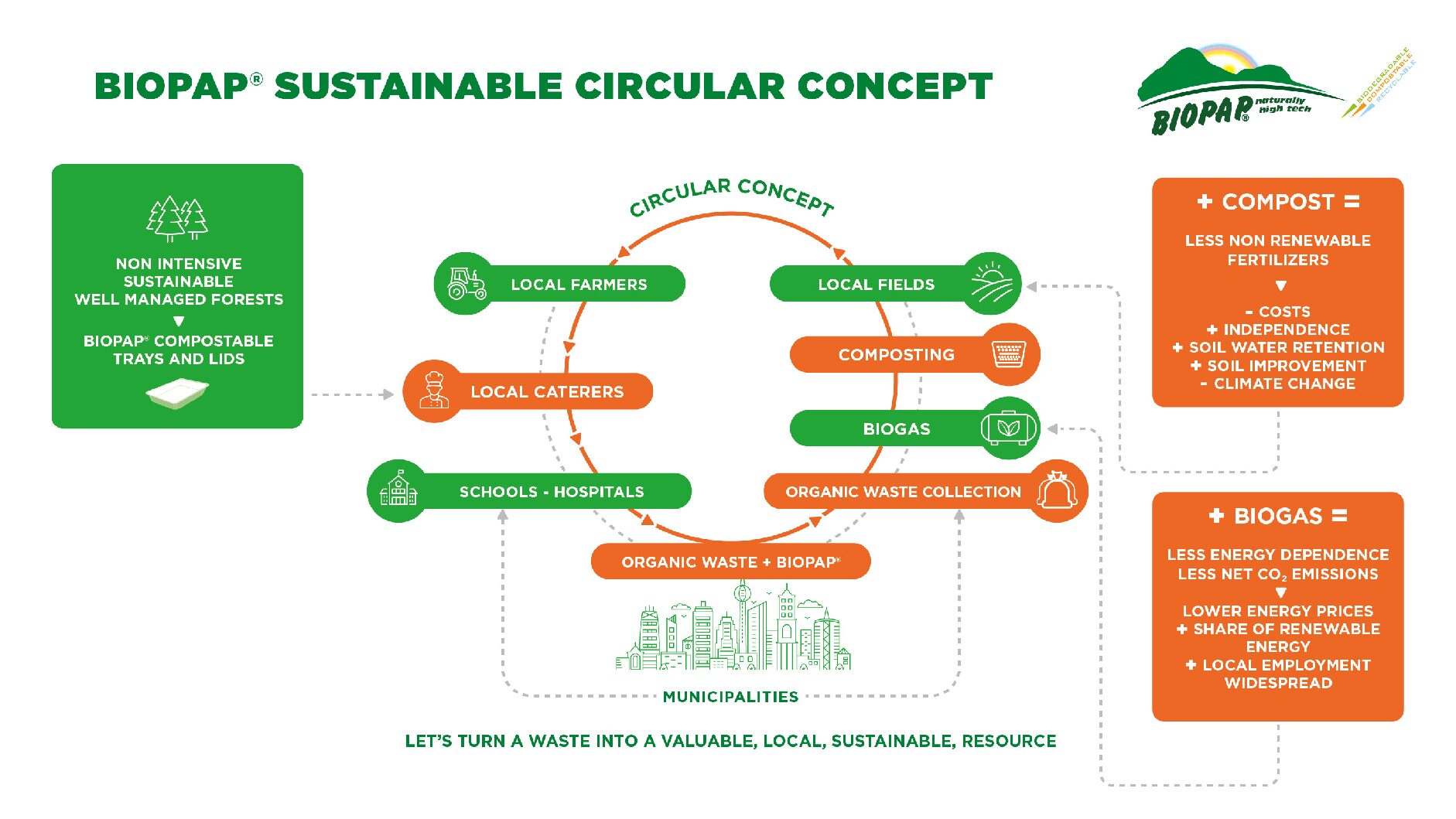
    Stop wasting bio-waste, turn it into compost: a virtuous circular resource benefiting agriculture and the natural cycle.

    Too often we forget food is essential to life and that food is grown on soil. Direct Human activities together with Climate Change are affecting significantly soil’s health. However good and healthy soils are vital to cope with raising population, and growing food needs but also in carbon sequestration and storage so as to water depuration. Therefore, soil quality and health are central to fighting against climate change, ensuring biodiversity and food security.

    95% of food on our planet is produced by the thin upper layer of soil. Human activity is causing daily soil degradation through loss of organic carbon and contamination at an alarming pace, especially when we think it takes from 100 to 1000 years to create 1 cm of fertile soil from rock. According to FAO, by 2050 soil erosion will have removed 75 billion tons of soil putting at risk 10% of crops, not to mention that soil is the second largest Carbon storage on the planet next to oceans. It is not just a matter of quantity but of quality. The quality and fertility of soil are measured by the quantity of organic substances in it. Organic substances are the residues of plants, animals, and microorganisms at different levels of decomposition. In Europe already 25% of soils are below the minimum threshold level of fertility due to the intensive use of chemical fertilizers. Losing organic carbon content in soils means not only reducing their naturally nourishing properties but also reducing their fertility. In addition to the loss of organic carbon, soils are also showing growing contamination from pollutants all generated by human activity such as chemicals (pesticides, Nitrogen..) and plastics. It has been calculated that the amount of dispersed plastics in soils is even higher than the one in the oceans. These contaminants are responsible for 20% of agricultural global yield reduction. In the EU commission “Study on sustainable agriculture and soil’s preservation”, less organic carbon in soils means less food, less biodiversity, less water filtration capabilities, less water retention, and therefore also faster erosion: A vicious circle we can and must stop.

    The good news is in 2023 urban organic waste separate collection has become compulsory in the EU (EU Directive 2018/851). This needs to be taken as an enormous opportunity to turn waste into a local, circular resource, becoming a key factor to fight against climate change through soil improvement.

    Bio-waste, including compostable certified food packaging, mainly comes from households, restaurants, and caterers and is collected in urban areas. This waste can be treated locally, in peri-urban sites, and made available to local agriculture saving transport and CO2 emissions. Replacing chemical fertilizers with compost improves soils with essential natural organic carbon that is key to fertility and carbon storage. Moreover, compost remains rich in moisture and natural microorganisms that help soils retain more water and give higher filtering capabilities when it flows through. A moist soil also reduces its erosion. These are essential additional factors to fight against climate change when lower rainfalls are expected in future years. In addition, there is also a cost advantage for the community. Non-renewable fertilizers are particularly expensive nowadays as they come from fossil-based methane. Replacing them with Compost is an economic advantage for farmers helping them to reduce cost inflation to the whole food value chain.

    It is nonsense to send this precious bio-waste to incineration or landfilling just because waste management companies/systems are not yet ready for composting. Organic waste consists of water at a minimum level of 75%. It is an energetic paradox to incinerate this waste. CO2-emitting fuel would be spent to simply turn water into water vapor for over 75% of its weight! It would also be a waste, to landfill Bio-waste preventing it from bringing all the described benefits to agriculture.

    Italy is an inspiring positive showcase. It is the leading country in volume and experience in Europe to best use this valuable resource and turn Bio-waste into compost. In 2020, organic waste was accounting for over 40% in weight of the total urban waste separate collection. Figures for the next years will grow even further as, starting from 2022, all Municipalities across Italy have organized separate organic waste collection. The collection of EN 13432 compostable-certified food packaging with organic waste has been in place for years and brings value to the process by adding dry compostable content and additional renewable organic carbon. By collecting separately and turning bio-waste into compost, a virtuous circular system has been established. In 2020, 4,6 Mio T of urban organic waste have been collected and treated to produce 2,2 Mio T of Compost which has led to storing 375.000 T of organic carbon in farming lands though saving 4,3 Mio T CO2 equivalent per year compared to landfilling. Compost has been made available at 70% to local farming activities, and to Organic farming, closing the circular loop. This positive system has proven to be economically viable and competitive both from the economic and environmental points of view. There are 358 composting treatment sites in Italy of which 294 are direct composting sites, and 65 sites are integrated Anaerobic-Aerobic. In addition to direct aerobic composting plants, organic waste can also be treated in anaerobic digestors to produce Bio-Methane and C02 that can be separated into industrial gases. The residue of Anaerobic digestion then goes to aerobic composting mixed with wood waste and turned to compost. 312 Mio m3 of Biogas have been produced in 2020 equivalent to an electric power generation of 664.000 GWh and a production of 100 Mio m3 of Biomethane.

    We must stop wasting bio-waste bringing them to landfilling or incineration. Europe and North America must further accelerate in promoting separated bio-waste collection and its biological recycling to compost: a simple, low cost and effective system to turn waste into a local, circular resource that significantly helps in the fight against climate change, improves soils, preserves food quality&safety and farmer economics.

    At BIOPAP® we started with renewable raw materials and a clear end-of life project over 20 years ago having the whole range certified CIC compostable, back in 2009 with the license N°3 in Italy. We have designed and developed a unique range of high-performance convenience food packaging, fully compostable with food and kitchen waste to be biologically recycled and turned into Biogas and Compost.

    News

    BIOPAP® compostable, ovenable food trays now part of the USDA BioPreferred® Program

    Our sustainability journey started over 20 years ago. From the very beginning BIOPAP wanted to develop all its high-performance food containers using renewable and non-intensive raw materials and taking into consideration its end-of-life.

    To underline this commitment in a scientific way, we have chosen and obtained the voluntary USDA CERTIFIED BIOBASED PRODUCT certification for all our food containers. The USDA CERTIFIED BIOBASED PRODUCT label indicates that a product is entirely or in significant part composed of renewable bio-based raw materials.

    This certification aims to promote the development, purchase and use of bio-based products, alternative to traditional ones derived from fossil sources, and to increase the use of renewable agricultural resources, thus helping to reduce negative impacts on the environment and health.

    Through this certification BIOPAP® entered the USDA BioPreferred® Program and also qualified for mandatory Federal Purchasing in the United States

    This label assures the consumer that the product contains a verified amount of renewable bio-based components indicated as BIOBASED content. In addition to being renewable, BIOPAP® freezer-to-oven resistant food containers have been developed from non-intensive sources that do not require artificial watering, pesticides or chemical fertilizers.

    The analyzes performed are third-party certified and rigorously monitored by the USDA.
    Products participating in the voluntary labeling initiative have their organic content measured by pMC (percentage modern carbon) using ASTM D6866-22 methodology as part of the certification process.

    A value of 100% BIOBASED carbon indicates that 100% of the carbon comes from biomass and a value of 0% indicates that all carbon is from petrochemicals, hard coal or other fossil sources. An intermediate value indicates a mixture: the higher the value, the greater the presence of natural organic components in the material.

    BIOPAP® compostable food containers BIOPAP® LP, BIOPAP® LC and BIOPAP® MAP have a Biobased carbon content ranging from 97 to 100%. This provides additional safety for the use and the disposal of BIOPAP® food packaging without negative impacts for our planet and our health.


    News

    Sustainable and 100% natural fresh pet-food producer Bark Park Dubai awarded with BIOPAP® compostable trays

    Sustainable and natural fresh pet food producer Bark Park Dubai has been awarded with the ANIMALIA PET INDUSTRY AWARD 2022. We gratulate Jan Almheiri for her strong commitment and passion to pet well-being and for her vision and determination as a women entrepreneur.


    BarkPark is producing and delivering freshly cooked natural pet food in fully sustainable and compostable BIOPAP® trays through semi-automatic BIOPAP® Easy System. Pet food is hygienically top-sealed into BIOPAP® compostable containers and delivered to customers deep frozen to keep the best nourishing properties for the animals. Thanking to their extreme heat resistance, BIOPAP® trays are used deep freeze and store the fresh pet food. When needed, BIOPAP® Packs are then defrost at room temperature or in microwave ovens or in traditional oven and then served to our “best friends”. Once used BIOPAP® trays are disposed with food kitchen waste and turned into valuable compost to be used back into agriculture.

    Compost mixed with soil helps to improve water retention and soil quality reducing the need of artificial watering and non-renewable fertilizers.

    Bark Park in Dubai offers also complete services for Pet well being, training and resting services with the maximum care for the animals and for the environment. We wish Bark Park (https://www.barkparkdubai.com) further success in its expansion as more and more customers throughout the Emirates are enjoying the best quality and environmental performance of the concept.


    News

    The Italian Composters Consortium (CIC) celebrates its 30th anniversary

    BIOPAP® congratulates CIC for their 30th anniversary, a common long-lasting commitment in turning a waste into a valuable local resource.  Our dual-ovenable food trays have been specifically designed over 20 years ago to end their life in composting plants together with food waste or at home composting units, with the best purity. At BIOPAP® we are proud of our Compostability certificate License N°3, we have been the second company in Italy to get all its products certified compostable with the Italian Composters Consortium. Italy is the Best Practice Leader in BIOWASTE management through compost, producing renewable fertilizers or renewable biofuel. Italy’s biowaste collection reached in 2020 40% of the whole urban waste collection producing 2,15 million T of compost and 370 million m3 of Biogas. The BIOWASTE collection and the best management through compost will play a crucial role in the next years to fight against the climate change and desertification. BIOPAP trays perfectly biodegradate and disintegrate into compost, improving soils, water retention and bringing organic substances or can be digested in anaerobic digestors to produce biogas.

    Certificate of compostability of BIOPAP LP, BIOPAP LC, BIOPAP MAP and LP Lids


    News

    All disposable packaging and items containing PFA’s are no longer compostable. Once again the strategic vision of BIOPAP® confirms its choice to never use fluorinated compounds.

    Packaging and disposable products containing PFAs will no longer be certified compostable to EN 13432.


    Growing concerns about public health and soil contamination have led various Certification Bodies to ban single-use packaging and products that contain PFAs.


    The call was already active in the US from 2020 when the BPI restricted the criteria for packaging and compostable products by eliminating any PFA’s from the composition of the products.

    https://bpiworld.org/Fluorinated-Chemicals


    Even in Europe, organizations such as TUV Austria (OK Compost Industrial and OK Compost Home, Seeding), Compostable CIC, European Bioplastics have adopted the same criteria.


    From 1-1-2022 paragraph 8.1.4 on the chemical characteristics of the products of the OK Compost Industrial and OK Compost Home certification scheme based on the EN 13432 Standard reads:


    As specified in EN 13432, the total concentration of Fluorine of the product must not exceed 100ppm. To further limit the use of perfluorinated or fluorinated chemicals, each applicant must sign a self-declaration that no PFAS (as defined by the OECD, see §12.4.) is added to their products: https://www.tuv-at.be/fileadmin/user_upload/docs/download-documents/CS/CS-OK01-EN_OK_compost_INDUSTRIAL.pdf


    The definition and identification of PFAs is that published by the OECD.

    https://www.oecd.org/officialdocuments/publicdisplaydocumentpdf/?cote=ENV/CBC/MONO(2021)25&docLanguage=En


    In summary, all certificate holders and new applicants must provide a self-declaration that no PFAS substance has been intentionally added to the product or during the manufacturing process. This self-declaration must be submitted no later than 01 July 2022. Otherwise, the validity of the certification will be suspended until the declaration is issued. In the absence of the requirements, the certification will lapse or cannot be renewed.


    To avoid further contamination of the soil, products containing PFAs will no longer have to be thrown and collected in the wet fraction and sent to composting facilities.


    Already over 18 years ago, in the development phase, we deliberately discard any fluorinated additives for the production of our food containers. A further guarantee for choosing BIOPAP® heat-sealable food containers.  The innovative compostable BIOPAP® dish, designed for professional catering, is PFAs free and is therefore a guarantee of compliance with all standards. It allows a safe use and disposal without risk of contamination of the land and water with a Quality compost. One more reason to choose BIOPAP® dishes from renewable and non-intensive raw materials, with a totally European supply chain and production in Italy. At reopening of schools, catering activities and autumn festival, only certified supplies of dishes and containers suitable for composting with adequate certifications shall be taken into consideration. BIOPAP® biodegradable and compostable trays and dishes are the safe, high-performance choice! The guarantee of a unique experience that has its roots in over 18 years of Italian development and production, dedicated to utmost safety up to composting.


    News

    BIOPAP® MAP receives the prestigious ADI PACKAGING DESIGN AWARD 2022

    Established by the Industrial Design Association to enhance the most innovative Italian packaging, ADI PACKAGING DESIGN AWARD 2022 has been awarded to BIOPAP for the innovative and patented MAP containers. Celebrating its fifth edition, ADI not only rewards the packaging itself but also intangible aspects of the production process along the lines of research and innovation. Filippo Rossi, managing director and co-founder of BIOPAP®, received the prestigious award on the occasion of Marca, the Italian trade fair trade show organized by BolognaFiere with ADM, the Association of Modern Distribution.

    #design #Biopap #innovation #packagingdesign

    A recognition for the research and innovation developed with BIOPAP® MAP containers that offer a renewable cellulose-based alternative for the packaging of foods in a modified atmosphere with a very high oxygen barrier and perfectly compostable that can be used in the freezer, oven and microwave.

    The best way to enhance healthier foods from controlled supply chains in a container that increases shelf life without preservatives. BIOPAP MAP is pleasant to the touch, printable, functional and easily disposed of in the organic waste to become a new resource in compost and return to agriculture, thus completing an endless virtuous cycle.


    News

    Unique and Patented BIOPAP® MAP tray launched at the Italian Pavilion EXPO DUBAI 2020


    BIOPAP® was proudly officially presenting on the 16-03-2022 its new ground breaking patented innovation BIOPAP® MAP at the Italian Pavilion EXPO DUBAI 2020.

    Organized by ITA (Italian Trade Agency) in this prestigious frame, 9 selected SME with core focus on sustainability, have displayed their spear head specific know-how to the community and local investors.


    BIOPAP® has been selected for its patented cellulose-based food tray suitable for Modified Atmosphere Packaging, biodegradable compostable and recyclable, resisting from -80°C to 145°C.


    4 years of intense R&D development have led to both a material and converting technology development featuring, high Oxygen barrier, Gas tight sealability, heat  resistance to microwave and traditional ovens though being fully compostable at industrial scale with CIC certification.


    BIOPAP® MAP is a new frontier in food preparation and service allowing best organoleptic food experience, longer food shelf life without preservatives and food waste reduction.


    Another big step towards sustainability for the food industry bringing renewable, non intensive raw materials to accompany food hand in hand in preparing, sealing storing, reheating and serving it. BIOPAP® MAP allows best consumer convenience. Furthermore BIOPAP MAP offers high  product differentiation through natural touch and feel, optimal communication with printable surfaces and perfect end-of-life in compost, turning a waste into a local circular resource.
    Notizie

    BIOPAP Certified ISO 9001:2015

    Our quality management system was already designed in the early stage according to ISO 9001 guidelines to drive our innovation process and our production. In 2020 we have decided to go for the certification to strengthen our strategic review and allow our customers a faster approval path for the biodegradable, compostable and recyclable BIOPAP® Food trays. On November 2021 we went through the ISO 9001:2015 audit and got the certification without a single remark. Throughout the years we have integrated our know-how and our competence into sound and reliable procedures giving further boost to quality consistency and innovation. This milestone is an achievement of all our people committed to common successful goals.